June 19, 2026
The National Council of Indigenous Midwives (NCIM) and the Canadian Association of Midwives (CAM), reject the International Confederation of Midwives’ (ICM) continued framing of Indigenous midwifery as one of terminology and professional standards, when the concerns raised by Indigenous midwives have consistently centred on Indigenous self-determination, Indigenous governance, and the recognition of multiple systems of knowledge, authority, and accountability.
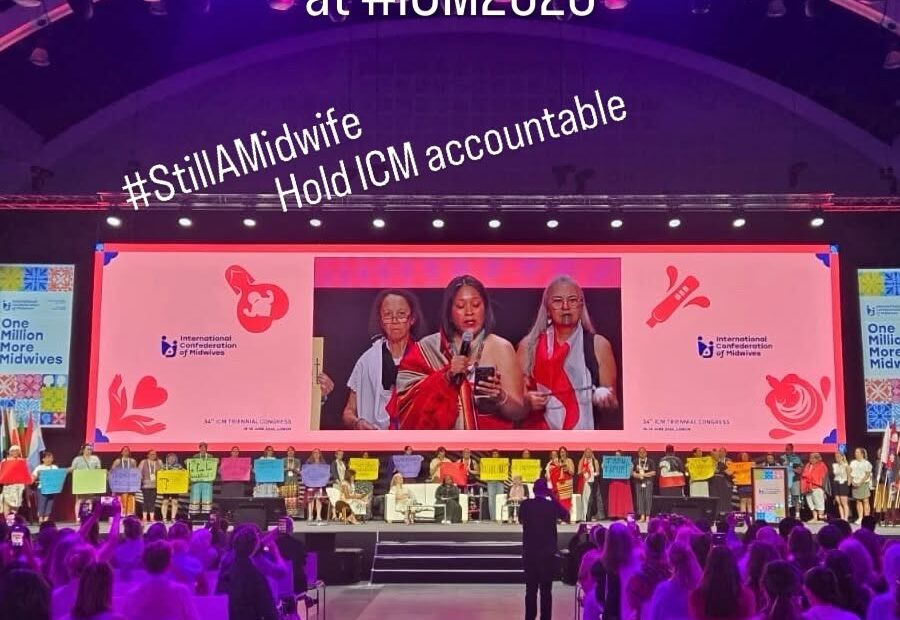
From across the world, Indigenous midwives arrived at the ICM Congress to learn that not only had the Position Statement on Partnership Between Indigenous and Non-Indigenous Midwives been suspended, but that the term “Indigenous midwifery” itself had been called into question within ICM’s policy and governance frameworks. For many Indigenous midwives, this was experienced not as partnership but as erasure.
Indigenous midwives want the same outcomes that ICM seeks: safe births, high-quality maternity care, strong health outcomes, professional accountability, and access to culturally safe care for women and birthing people, newborns, families, and communities.
CAM and NCIM reject the false choice between clinical competency and Indigenous knowledge systems. Indigenous midwives have always carried both. ICM’s continued insistence that legitimacy flows solely through its own definitions and standards has done serious harm to the relationship with Indigenous midwives, harm that the Position Statement on Partnership intended to avoid.
Indigenous midwives are more than a credential. Many serve as health care providers, teachers, mentors, knowledge holders, language carriers, advocates, researchers, and community leaders. The knowledge they carry cannot be measured solely through academic credentials or regulatory frameworks. It includes generations of lived experience, cultural knowledge, community accountability, and responsibilities to future generations.
The United Nations Declaration on the Rights of Indigenous Peoples affirms that Indigenous Peoples have the right to maintain and strengthen their distinct political, legal, economic, social, and cultural institutions while participating fully in the life of the state. These principles apply to Indigenous systems of birth care, education, governance, and accountability, regardless of how they align with contemporary professional definitions or regulatory frameworks.
The work to develop the ICM Position Statement on Partnership Between Indigenous and Non-Indigenous Midwives did not begin in 2021. Indigenous midwives and allies advocated for years before presenting a draft statement in 2017. What followed were years of consultation, relationship-building, negotiation, and leadership before its eventual adoption in 2021. The Position Statement represents nearly a decade of effort by Indigenous midwives seeking meaningful recognition within global midwifery governance.
The suspension of the Position Statement raises broader concerns about whether ICM is prepared to recognize Indigenous systems of knowledge, governance, and care on their own terms, and whether Indigenous midwives are being treated as true partners in decisions that directly affect them. Indigenous Peoples around the world continue to experience the impacts of colonial policies that have sought to marginalize, regulate, or replace Indigenous systems of health, governance, and knowledge transmission.
The events of the recent ICM Congress have exposed not only a disagreement about language, but a profound crisis of trust between Indigenous midwives and the institution that claims to speak on behalf of the global midwifery profession.
CALLS TO ACTION
CAM and NCIM call upon ICM to:
- Reinstate the Position Statement on Partnership Between Indigenous and Non-Indigenous Midwives until replacement language has been developed and approved.
- Establish permanent Indigenous representation within ICM governance structures to ensure Indigenous midwives are equal partners in shaping future ICM policy related to Indigenous Peoples, Indigenous midwives, and Indigenous systems of care.
- Undertake meaningful dialogue with Indigenous midwives regarding Indigenous self-determination, legal pluralism, Indigenous governance, and Indigenous systems of accountability within global midwifery.
- Undertake an independent governance review of the relationship between the ICM Secretariat, Board, and Council, including the processes through which policy decisions are advanced, communicated, and approved, to ensure transparency, accountability, and meaningful member engagement
If the global midwifery community seeks to achieve the goal of one million more midwives, Indigenous communities must be part of that future. Indigenous Peoples are not peripheral to the history of midwifery. Indigenous systems of birth knowledge, care, and accountability form part of the foundation upon which the profession stands today. The future of global midwifery will be strengthened not by narrowing definitions of who belongs, but by recognizing the full diversity of the world’s midwifery traditions, governance systems, and communities. Join us in celebrating the midwives from the Global South and their resilient efforts to keep families safe.