
CJ Blennerhassett, RM, MHA, CHE
To Read the full op-ed published in the Hill Times, May 5 2026, click the image below.
To read the op ed in its original form, continue scrolling.
May 5 2026–Canada’s health-care system is under strain. Across the country, people are struggling to access care, providers are burning out, and hospitals are stretched beyond capacity. These challenges are connected: access barriers, workforce shortages, inequity, and a system still too focused on reacting to illness instead of investing in care that keeps people well.
If the federal government is serious about health system reform, it must invest in models of care that expand access, support the workforce, advance equity, and reduce pressure on hospitals.
Midwifery does all four.

For 25 years, the Canadian Association of Midwives has supported the growth of midwifery as a regulated, publicly funded profession. Today, midwives are primary care providers who deliver comprehensive care during pregnancy, birth, and the postpartum period, in hospitals, clinics, homes, birth centres, and communities across the country.[1][2][3]
The evidence is clear: midwifery care improves patient experiences, delivers safe, high-quality outcomes, and reduces pressure on hospitals by providing the right care, in the right place, at the right time.[4][5]
And yet, access remains uneven.
Where you live in Canada still determines whether you can receive midwifery care at all.[1][2]
This is not because of a lack of demand. It is because of a lack of investment.
Canada does not have enough midwives to meet the needs of its population. Training seats remain limited, retention is challenged by unsustainable working conditions, and too often, midwives are excluded from leadership and decision-making tables where health system design is determined.[6][7][8]
In other words, Canada has not built the conditions required for midwives to stay, to lead, and to thrive.
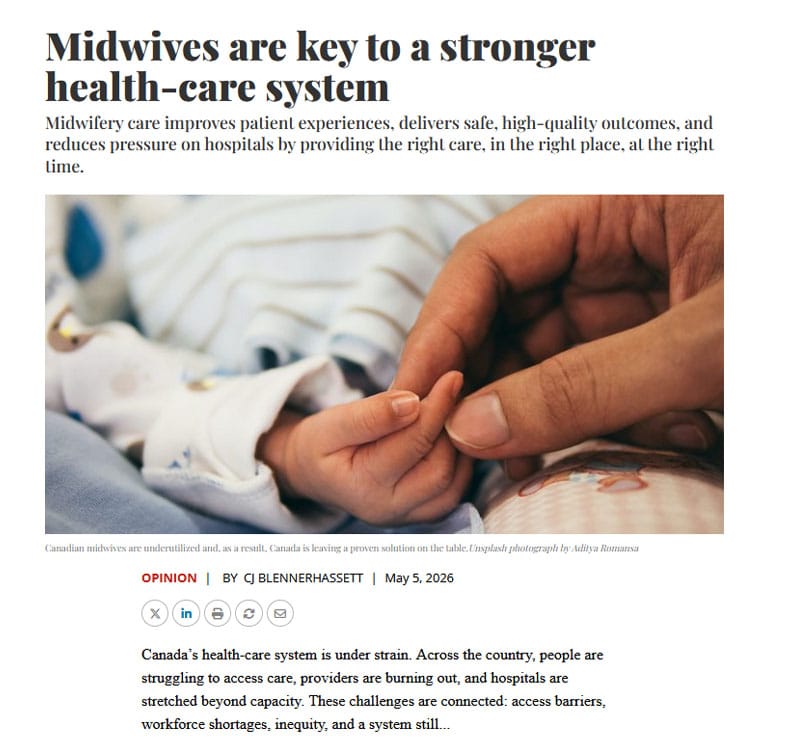
Canadian midwives are underutilized and, as a result, Canada is leaving a proven solution on the table.
At a time when governments are seeking to improve system capacity, midwifery offers a proven, cost-effective model of care that aligns directly with these goals.[5][9]
Midwifery care is community-based, relationship-driven, and focused on prevention and continuity. It is designed to keep people well, reduce unnecessary interventions, and ensure that hospital resources are used appropriately.[4][5]

Recent polling has shown that 85% of Canadians have a positive impression of midwives, 73% agree midwives play an important role in the health-care system, and 65% agree increasing the number of midwives is more important than ever given the strain on the health system.[10]
This is also the kind of care that Canadians are asking for: care that takes time, builds trust, and supports informed decision-making.
But scaling this model requires deliberate action.
The federal government has a critical role to play in strengthening Canada’s health workforce. This includes targeted investments in education and training, support for workforce mobility, and pan-Canadian approaches to data, planning, and retention.[9][11][12]
Midwifery must be part of this strategy. This means including midwifery explicitly in federal health workforce investments, data strategies, and funding agreements with provinces and territories.
Investing in midwifery is not about creating a parallel system. It is about strengthening the one we already have by ensuring that midwives are fully integrated into interdisciplinary teams and positioned as core contributors to health system performance.
It is also an opportunity to advance equity. Midwifery models of care are well positioned to improve access in rural, remote, and underserved communities, and to support Indigenous-led approaches to care that are culturally grounded and community-driven.[13][14]

After 25 years, midwifery in Canada is no longer new or marginal. It is established, proven, and trusted.
And what those 25 years have shown us is this: a thriving midwifery workforce leads to stronger health systems.
Canada cannot meet its health workforce and access goals without fully utilizing midwives.
The question is no longer whether midwives matter.
The question is whether Canada is willing to invest in the conditions that allow them to succeed.
If Ottawa is serious about building a more accessible, sustainable, and resilient health-care system, it cannot afford to overlook midwifery any longer.